Workout Nutrition Guide: Before, During and After Exercise
Get this right and your training starts working harder for you.
This is the question I get asked more than almost any other: what should I eat around my workouts?
The honest answer is that for most people, getting your overall daily nutrition right matters more than obsessing over the exact timing of every meal around training. But once your daily nutrition is dialled in, what you eat before, during, and after exercise genuinely does make a difference to your energy, your performance, and how well you recover.
Here's how I approach each phase, and what the research actually supports.
Free personalised nutrition plan
Why workout nutrition matters
Energy levels
Consuming the right nutrients before a workout gives your muscles the glycogen they need to perform. Carbohydrates are the primary fuel for exercise and having adequate stores prevents early fatigue and supports endurance.
Performance
The right nutrition supports muscle contraction, oxygen delivery, and sustained physical output. For longer or more intense sessions, topping up carbohydrates during exercise helps maintain energy and delay fatigue.
Muscle repair and recovery
Exercise creates micro-tears in muscle fibres. Consuming protein after training provides the amino acids needed to repair and rebuild that tissue. This is where your progress actually happens.
Adaptation and progress
Consistent training combined with proper nutrition produces the adaptations you're after: increased strength, better endurance, improved body composition. Nutrition is what supports and accelerates those changes.
Overall health
Eating well around your training supports your immune system, your energy across the day, and your long-term health. It's not just about what happens in the gym.
Before your workout
Timing
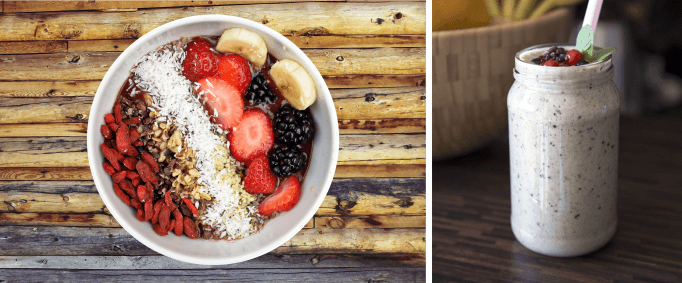
Eat a meal or snack containing carbohydrates and protein 1 to 3 hours before exercise. This gives your body enough time to digest and convert the food into available energy.
Carbohydrates
Choose easily digestible carbohydrates that provide reliable energy without sitting heavily in your stomach. Fruit, whole grains, oats, and low-fibre options all work well. Avoid anything high in fat or fibre immediately before training as these slow digestion.
Protein
Include a small amount of protein to support muscle repair before and during the session. Greek yoghurt, eggs, legumes, and lean poultry are all solid choices.
Healthy fats
A small amount of healthy fat from nuts, seeds, avocado, or olive oil provides sustained energy and supports overall health. Keep the portion modest before training.
Hydration
Drink water before your session. Arriving well hydrated makes a real difference to performance, especially in warm conditions.
During your workout
Hydration
Water is the priority during exercise. For shorter workouts under 60 minutes, water is all you need. For longer or more intense sessions, consider a small amount of easily digestible carbohydrates like a banana, a few dates, or a sports drink to maintain energy levels.
Carbohydrates
For sessions exceeding an hour, topping up with simple carbohydrates helps maintain blood sugar and delay fatigue. Energy gels, sports drinks, or fruit all work. For most regular gym sessions or shorter cardio, this isn't necessary.
Electrolytes
If you're training for more than an hour in heat or sweating heavily, replacing electrolytes becomes important. A pinch of salt in your water, coconut water, or an electrolyte drink can help maintain mineral balance.
After your workout
Timing
Eat within 30 minutes to 2 hours after exercise. This is when your muscles are most receptive to absorbing nutrients for glycogen replenishment and repair.
Protein
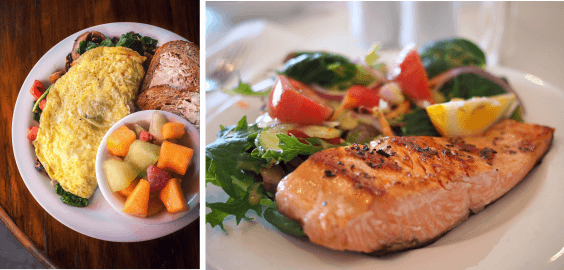
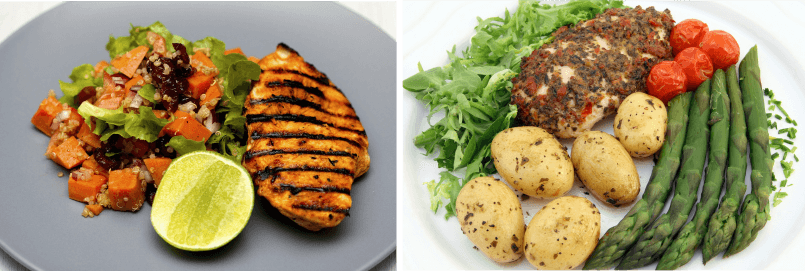
This is the priority post-workout. Aim for at least 30 grams of protein to support muscle repair and growth. Lean fish, chicken, eggs, Greek yoghurt, legumes, tofu, or a quality protein powder all work well.
Carbohydrates
Include carbohydrates to replenish glycogen stores. Whole grains, fruit, rice, potatoes, and legumes are all excellent choices. The amount depends on the intensity and duration of your session.
Healthy fats and antioxidants
Including some healthy fats and colourful fruits and vegetables post-workout supports recovery and helps reduce exercise-induced inflammation. This is another reason I always include vegetables and some fruit in my post-workout meals.
Hydration
Rehydrate after your session. If you trained hard or sweated heavily, drink more than you think you need.

My personal workout nutrition strategy
My primary focus is always hitting my daily macronutrient targets. If I've done that, I don't stress about precise pre or intra-workout nutrition. Getting the overall daily intake right is the foundation.
That said, my approach does vary depending on when I train. If I work out in the morning and had a solid dinner with plenty of complex carbs the night before, I'll often train on an empty stomach with just a coffee. Energy is not an issue because the carbs from the previous night are still providing fuel.
If I've been fasting for more than 12 hours and feel genuinely hungry, I'll have a light breakfast and wait a couple of hours before training.
If I train in the afternoon, I'll work out a couple of hours after a regular meal.
I don't use pre-workout supplements. Just coffee. During the session I drink water or sparkling mineral water.
Post-workout, I eat within a couple of hours. The meal always includes all three macronutrients and I make sure it contains at least 30 grams of protein. I also use a protein powder and creatine mixed into a shake or stirred through yoghurt at some point during the day.
My two favourite post-workout meals
Both of these meals contain over 50 grams of protein.
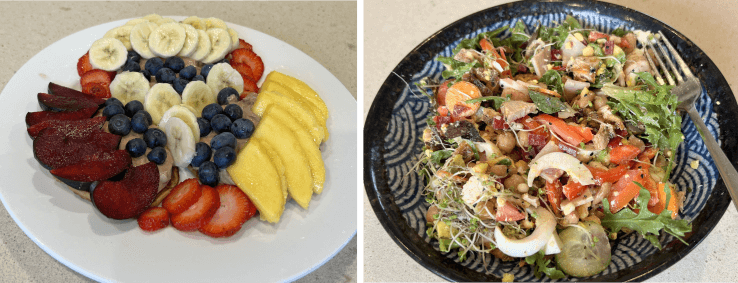
Protein pancakes with yoghurt and seasonal fruit
Three protein pancakes topped with a mix of protein powder and Greek yoghurt, then loaded with a generous serve of whatever seasonal fruit is around. It's satisfying, it looks great, and the protein and carbohydrate combination is perfect for recovery.
Salad with vegetables, legumes, nuts, seeds, eggs and chicken
A big salad with a wide variety of vegetables, legumes, nuts and seeds, two eggs, and BBQ chicken breast or turkey breast. Dressed with a honey mustard vinaigrette. This one has everything: protein, complex carbs, healthy fats, fibre, and phytonutrients all in one bowl.
For more information on workout nutrition, click to view these articles from Precision Nutrition:
Best workout nutrition strategies
Health should feel like your best life, not a break from it.
Marco ☕
About Me

I'm Marco Asnicar, personal trainer, nutrition coach and founder of Vitality Marco. I didn't discover the Mediterranean method. I grew up living it, shaped by Italian roots, real food and movement as a natural part of daily life. It took me until recently to realise that what always felt completely normal to me is exactly what most people spend years searching for.
I coach men and women aged 35 to 55 to do the same. No restriction. No fads. No giving up the life you love. Just a way of eating and living that genuinely feels good and gets better every year.
Want to know more about my story and approach? Read my full About Me page.